Why I Built HEATCOACH
Why would anyone build something that already exists, and frankly isn’t bad at all?
I had quite a few reasons.
How I ran my business
I’ve been an online fitness coach for almost 7 years. For the better part of those years, I ran my business through DMs, Excel spreadsheets (later Google Sheets, for convenience), Google Docs and Notion. It was a bootstrapped setup that “just worked”. If you coach online, you can probably relate.
The platforms I tried
Twice, I tried the established coaching platforms.
First, TrueCoach. It was good, and the interface was responsive, but it wasn’t structured the way I work, and it created a new set of problems for me to solve. Some of the features I wanted sat behind higher plans, so I still had to keep some of my old tools running next to it. Once I passed a certain number of clients, the price climbed with my roster, which didn’t feel like good value at the time. My clients had to track their diet in a separate app, which I wasn’t a fan of. And the “massive” exercise library was padded with duplicates and exercises I’d never program. So I uninstalled it and went back to my bootstrapped system.
Then Trainerize. It was also good. The interface felt more modern, and I could get pretty far with it. But I ran into the same issues almost immediately. Programming wasn’t as deep as I needed, my clients had to use a separate diet-tracking app again, and the exercise library had the same problem. I uninstalled it and went back to my own system.
Both have changed since I used them, and both are still good products. They just weren’t built for the way I work. If you’ve used either, some of this probably sounds familiar.
Building my own
I majored in IT engineering and was pretty good at coding, so I figured I could make a simple platform with all my tools in one place: a database of every single thing I need to onboard a client. Workouts, foods, trackable progress metrics, automations, you name it.
I started using it with my clients, and they loved it. Then I showed it to a friend who’s also a coach, and he said, “This is great. Why don’t you sell it?”
A lightbulb went on in my head.
Sell it? I’d never considered it. The other platforms already existed. They have massive ad budgets, strong distribution, and a large base of coaches who have used them for years. How could I compete?
But wait. Big companies are heavy and slow. If they want to change something as small as the colour of a button or a line of text, it goes through email hell or a meeting. I’m small and light. I can change whatever I want, whenever I want. If I optimise it like hell, I can fix every pain point I had with the other platforms.
Let’s give it a try.
So I took my onboarding system and started building it into a proper app. The plan was to spend 2 to 3 months on it and take it to market.
I didn’t.
Counting from that first bare-bones version, I’ve now spent almost 2.5 years on it. I polished the interface, optimised everything, made it fast, made it snappy, made it intentional. I put every tool exactly where I wanted it. I added the features testers asked for, and then I tested everything over and over, so that not a single coach would run into the problems I had with the other platforms.
What I fixed
Here’s where those years went.
This is what onboarding a new client used to look like for me: a spreadsheet for the training, a Google Doc for the diet, a Notion page for check-ins and my notes, and a message telling them to download Cronometer to track their food, with instructions on how to use it. It took me an evening, on average.
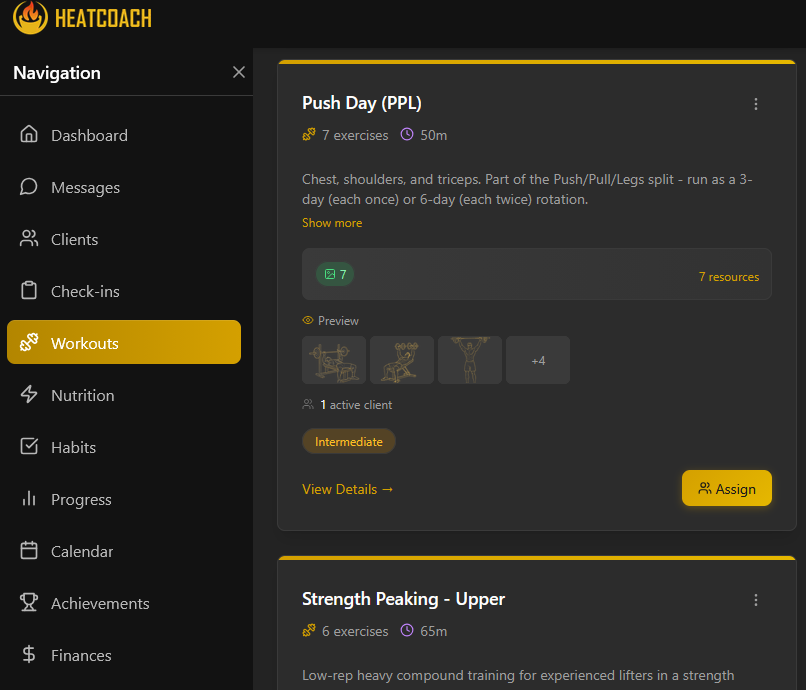
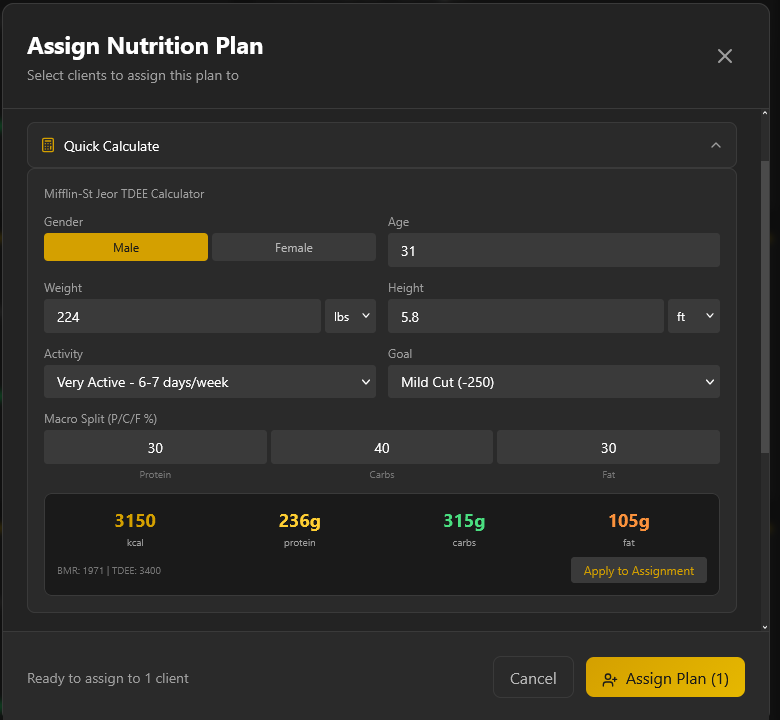
Here’s what it looks like now. I pick one of the template diet plans, and the calculator tailors the macros and portions to their height, sex, weight and goal. I swap a couple of foods because the client is sick of chicken breast and sweet potatoes. They log their food right there, no second app needed. I build their first month of training down to the set, dropsets and failure sets included, from 107 illustrated exercises or from my own, with my own videos, and I set custom targets, each with a date for when it should be hit. I choose the metrics I want them logging, like weight and waist, and the habits and check-ins I want from them. Then I go watch a movie, or start my 57th Elden Ring playthrough.
It takes 5 minutes. And when something goes wrong three weeks in, I open a graph and see exactly what happened, instead of scrolling back through months of DMs.
The achievement system
What I’m proudest of, though, is the achievement system.
A lot of my clients are gamers. Over the years, several of them told me the exact same thing, at random times and completely unprompted: tracking everything gets boring sometimes, and they wished they could unlock achievements the way they do in their games. That would make it so much more fun.
As an avid gamer myself, I knew exactly how they felt. I still remember getting the platinum in Bloodborne, the trophy you only get by unlocking every other trophy in the game. I still remember finally beating that miserable fishing minigame in Final Fantasy XII and getting the platinum there too. And I still remember the satisfaction when the trophy popped after I beat Lingering Will in Kingdom Hearts II.
How do you turn the whole span of a lifting career into achievements that apply to practically every trainee, from their first day of training until they’re a seasoned pro? If training were a video game, what would its trophy list be?
I interviewed tons of people and figured out where their experiences converge: the moments nearly every lifter goes through, whoever they are. There was a lot of friendly ball-busting over what deserved to make the cut.
Then I built it: an achievement system that does what video game trophies do. There are 60 of them.
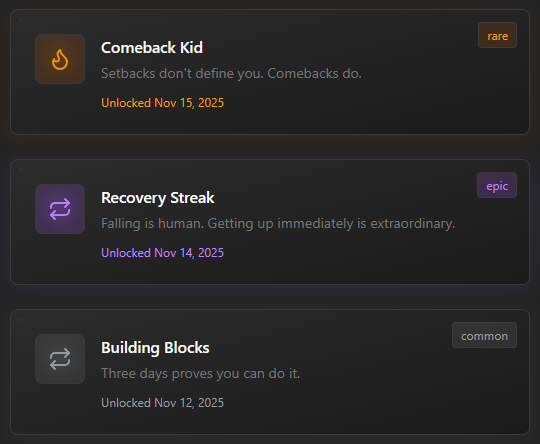
Some are secret, the way the best trophies are, and stay hidden until you earn them. And yes, there’s a platinum.
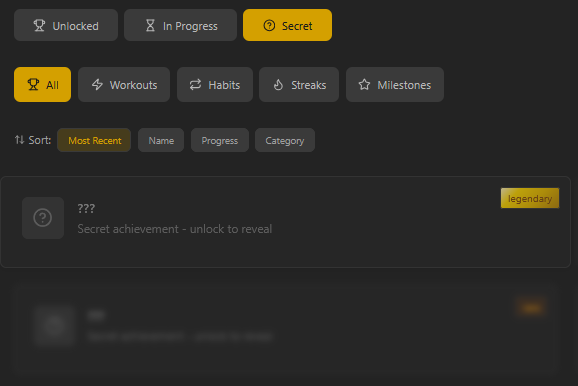
My clients loved it. One of them trained on his birthday and unlocked an achievement for it, and he was over the moon. Another felt bad about breaking his workout streak. When he got back to it, he unlocked an achievement for picking himself up and getting back on track. He told me it motivated him, and that he stopped feeling bad about himself.
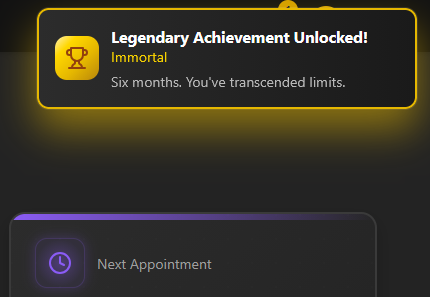
This is starting to sound like a pitch, but I’m damn proud of how it turned out. A client once told me: “I was about to give up because the progress is slow, but I noticed I had 25 of the 60 achievements, and I’d feel bad if I just quit without getting them all, thanks.”
I grinned like a kid. Good thing that one was over text.
If you coach online, you know what that message means. Writing the program is the easy part. The hard part is keeping someone going through the weeks when progress is slow, because that’s when clients quit. Anything that gets them through those weeks keeps them getting results, and keeps them with you.
The numbers
The workout system felt right.
The nutrition system felt right.
The progress tracking felt right.
The habit tracking felt right.
The check-ins felt right.
The automations felt right.
The messaging felt right.
The payment tracking felt right.
The analytics dashboard felt right.
The achievement system felt great.
And because I’d optimised everything to death, I realised I could finally solve, for everyone else, my biggest complaint about the other apps.
I could give coaches unlimited clients and every feature at one flat, fair price.
Goddamn it. I must be wrong. Surely I missed something.
I ran the numbers. I ran simulations. I load-tested it. Then I did it all again.
Holy shit.
Finally, my perfectionism paid its overdue rent for hanging out in my head all these years.
So that’s how the plans work. Every plan, including the free one, comes with every feature. What changes between them is how many clients you can take on, not which features you get. The free plan covers your first client, so you can try it with one before you move anyone else over. And on Max, the number is unlimited, at one flat price. Have a look at the plans.
For gyms, studios and coaching teams, there’s an enterprise version on the way: your own app, built on HEATCOACH, with your brand on it and none of mine, shaped around the way your team works. If that’s you, get in touch.
Why it took so long
Obviously, I wanted to contain my excitement. I’d built something I consider great, and every tester and coach I gave it to agreed, but the open market isn’t so nice.
So I took even more months, pushing the launch back again and again, to test everything down to the last byte and make sure absolutely nothing could go wrong for anyone. I wrote about that decision in On the Precipice.
I was building this for young Nick, who was broke and wished something like it existed. I couldn’t let him down.
If you’re running your coaching business on DMs and spreadsheets right now, the way I did for years, this was built for you too.
And here we are.
HEATCOACH is the amalgamation of everything I’ve learned, every skill I’ve picked up, all the experience I’ve gathered, and every late night spent heavily caffeinated instead of asleep.
I sincerely, with my whole heart, hope you enjoy using it as much as I enjoyed building it.